
The Scar Is the Certificate: How Our Numbering System Works
In this article
Every Thunderwood Guardian listing makes the same claim: one scar, one object, one record. A claim like that is only as good as the records behind it. So this article is about the records — why the scar itself cannot be duplicated, what the hand-numbered card says, what the serial on the sealed bag does, and how to check all three against one another when the box arrives.
Why the Scar Can’t Be Duplicated
When lightning reaches a tree, the current runs through the outer wood toward the ground and carbonizes a channel on the way — the pale, branching trace these pieces are known for. The figure has a name in physics: the same fern-like pattern appears when high voltage crosses an insulating surface, which is why it can be studied in a laboratory as well as in a forest. The shape of the channel depends on where the current entered, how wet the tree was that day, and how the grain had laid itself down over years of growth. None of those variables repeats.
The preference for this material is old enough to be written down. A Song-dynasty divination manual quotes an older text ranking thunder-struck jujube heartwood first among three woods — a recorded judgment about the material itself, not a claim about results, and that is how we quote it here. It is also why carvers do not re-cut a struck piece: cutting into the channel does not reproduce it, it removes it. And it is why imitations cluster on the surface — paint, torch scorching, scratch marks that sit on top of the wood instead of running through it. We put the five checks for telling the difference in one place, here. What a strike changes about the wood itself is covered in the article on how lightning changes wood.
The Numbering Card
Every piece is hand-numbered, and the number is written on a card that travels in the box. The card records which design the piece is — one of the eleven Thunderwood Guardian carvings — and the piece’s number within that line of work. Functionally, it binds three things together: the listing photographs, the design description, and the object in the box. A hand-carved piece will never match its photographs exactly, and nobody should expect it to; the number is what says this listing, this card, and this object belong to one record.
The card is paper, not a database, and we describe it that way on purpose. Its value is not mystery; it is that it gives you something specific to check against when the piece arrives.
The Serial on the Bag
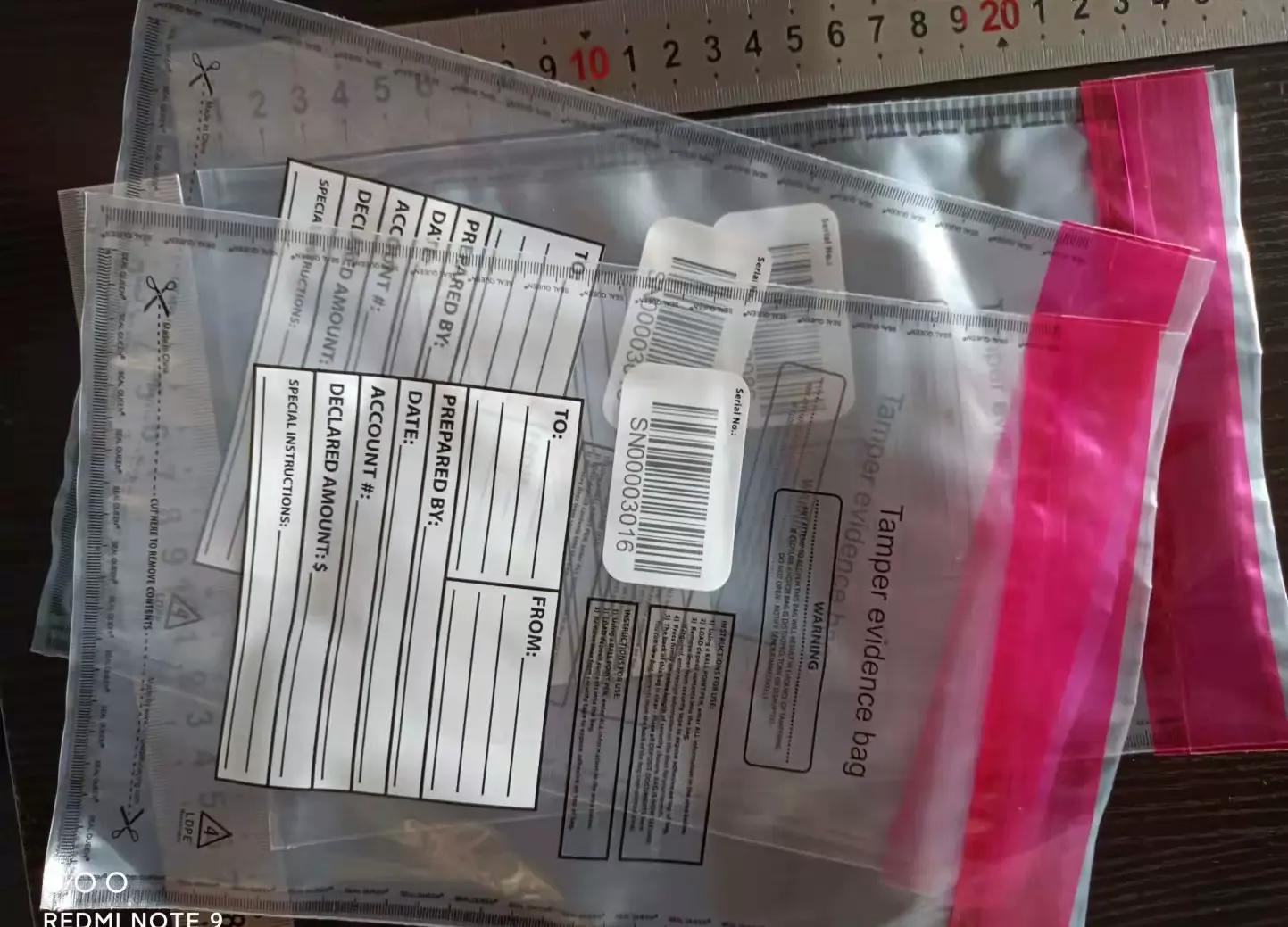
The second record sits on the outside of the sealed bag. A white barcode sticker carries a serial in the SN00003016 format, on a printed form with fields for TO, FROM, PREPARED BY, DATE, ACCOUNT #, DECLARED AMOUNT and SPECIAL INSTRUCTIONS. A red tamper strip closes the top edge, gauge marks run along the side, and CUT HERE TO REMOVE CONTENTS marks the opening line. The bag is a single-use security bag of the kind used to move cash, and the logic it borrows is chain of custody: whoever opens the seal destroys it, and the condition of the seal is readable by everyone downstream.
For a one-of-one object, that chain matters. The bag ties the piece that left the bench to the piece that reached your door, and the serial gives the journey a number you can quote in an email if anything ever needs sorting out. The bag in the photograph is the real article; the fields are printed, the sticker is per-piece, and the strip only opens one way.
How to Verify a Piece on Arrival
A short checklist, in order:
- The scar against the listing photographs. Same channel, same branch pattern, same placement on the piece.
- The carving against the design photographs. Hand work varies slightly piece to piece; the composition should not.
- The card number against the bag serial. They travel together and should agree.
- The seal strip. Intact if you have not cut it, and cut only by you.
If any of the four fails, stop before cutting the seal and write to support@longhucrest.com with photographs. A mismatch is exactly what the record system exists to catch, and a mismatch found with the seal intact is the easiest kind to resolve.
Why One-of-One Is Material Fact
There is a phrase we use for this: lightning never signs twice. It is not a slogan about craftsmanship; it is a description of physics. The current that made a scar took one path through one tree on one day, and no later strike walks the same path. Two blanks from the same branch, split by the same storm, will not match. Scarcity of this kind is structural rather than staged — the article on rarity walks through it honestly, which is to say, through the absence of round numbers.
Two clarifications keep the claim honest. First, the literal one-of-one claim belongs to the natural line — wood that was actually struck — while standard-line pieces are hand-carved from cultivated wood, individually varied by the hand, and described as such. Second, the claim is checkable, and that is the point: scar, card, serial, and listing form a loop that closes. Where the story ends and the spec begins is written down in our buying checklist.
Frequently Asked Questions
Can two pieces carry the same number?
No. One number belongs to one card, one sealed bag serial, and one piece. The numbering is done by hand on the bench, piece by piece, and a duplicate would break the loop the system exists to close. If you ever hold two pieces whose cards show the same number, or a card whose number disagrees with its bag serial, photograph both and write to support@longhucrest.com. A records failure is the one thing this system is built to make loud, and a mismatch report is the fastest way to get it fixed.
Is the scar on a standard piece real?
No, and no listing of ours says otherwise. Standard pieces are carved from cultivated jujube wood, and their storm-marks are recreated — the wood is electrically treated to mimic what a strike does. The real article is the natural line: struck wood found after storms, sold as one-of-one pieces at the top of the range. We keep the two lines separate on purpose. The story a piece tells should match the spec of the piece in the box, and on the standard line the spec plainly says recreated.
What if the card and the bag serial do not match?
Treat it as a records failure and write to support@longhucrest.com before opening the seal. Send photographs of the card, the serial sticker, and the piece as seen through the bag. The card, the serial, and the listing are supposed to agree; when they do not, that is precisely the situation the checklist above is designed to catch, and a mismatch reported with the seal intact is the easiest kind to sort out. Keep the seal uncut until the question is settled; the intact seal is what keeps every option open.
Does the number change the price?
No. Price in the Thunderwood Guardian series follows size and carving depth, running from $88 to $299 across the eleven designs. The hand-numbered card and the sealed bag are part of how every piece is handed over, not an option you pay extra for. What the number changes is accountability: it is what lets you check the piece in your hand against the record that describes it, and it is what makes a mismatch reportable in the first place.