
How Lightning Changes Wood: Carbonization, Grain, and Figure
In this article
Lightning changes wood in four lasting ways: it lays down a thin layer of carbon along the strike channel, it browns a band of timber beyond the char with heat, it tears a furrow that runs with the grain, and it sets a color contrast no two pieces share. The char is carbon left in place, the band around it is heat-darkened timber, and the furrow always follows the fiber.
How lightning changes wood is a materials question, and this page answers it the way a carver would: what the char is made of and how deep it goes, what heat does to the wood beyond it, why the seam tracks the grain, how the timber behaves at the workbench, and what to look for when you buy. The cultural story — why people treasured storm-marked timber long before anyone asked what changed inside it — runs through our guide to lightning-struck wood.
What Exactly Does a Strike Change in the Wood?
A strike changes only a shallow envelope of the wood it touches: a carbonized channel, a heat-browned zone around it, and a torn furrow along the grain — with every fiber beyond left sound.
The heat that does the work is enormous but momentary. The University of Nebraska–Lincoln’s 2024 extension note on storm-struck trees measures a strike at up to 100 million volts and a temperature of up to 50,000 degrees F — heat spent almost in the instant it arrives. A pulse that brief cannot soak deep, so the changes it writes sit close to the surface: blackening where the wood converted to carbon, browning where heat alone reached, tearing where the channel split the fiber open. Sound timber begins immediately beside the seam — which is why a struck tree can keep growing, a question our tree-survival guide follows on its own. This page stays with the wood.
How Deep Is the Char Layer, and What Is It Made Of?
The char layer is thin: a crust of carbon lining the walls of the furrow, not a burn pit eating its way down through the trunk.
Char forms where wood is heated intensely with little oxygen present — exactly the situation along a strike channel buried under bark. A materials study in Scientific Reports defines biochar as created by thermochemically converting biomass in an oxygen-limited environment, and the crust along a lightning seam belongs to that same family of substance: carbon that keeps the shape of the fiber it replaced. A strike supplies its heat in a single pulse, so the crust never gets the time a slow fire would need to thicken.
What looks like depth in a lightning seam is the tear, not the burn. The channel splits open along the fiber and the char lines the exposed walls, so a seam can run a hand’s length down a trunk while the crust itself stays shallow enough to trim, smooth, and carve beside. That distinction — torn furrow with a thin carbon lining, versus timber burned through — is the first thing a carver reads when deciding what to keep and what to plane away.
Does Lightning Change the Wood’s Color?
Yes — and in two steps: the char itself is near-black, and a band of wood beyond it turns brown from heat alone.
Heat alone darkens wood; that is settled material science, not a peculiarity of storm timber. A peer-reviewed study of thermally modified wood states it plainly: After thermal modification, wood becomes gradually darker as temperature rises and time is prolonged. A strike simply runs that same chemistry at extreme speed, in a band a few fibers wide.
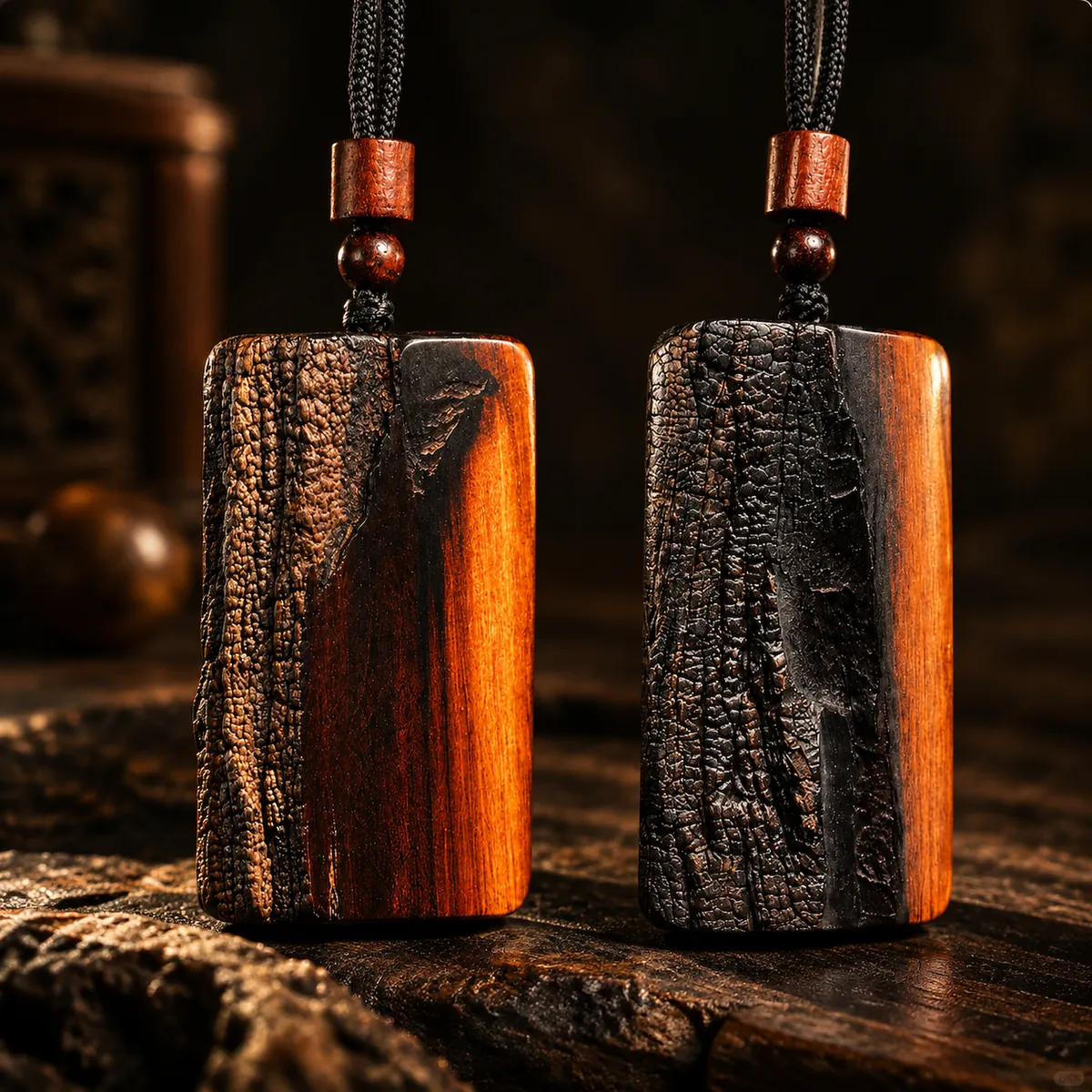
The color has a chemical author rather than a surface stain. As the same study records, the darkening arises inside the wood itself, when its own structural polymers degrade and rearrange into darker compounds — so the brown band belongs to the timber and cannot be wiped or washed off the way a dye could. Against jujube’s natural heartwood the difference reads clearly: sound wood runs red-brown to amber, the heat band deepens toward chocolate, and the char goes to matte black — three tones in one piece, with the band feathering along the pore lines instead of stopping at a clean edge.
Why Does the Scar Follow the Grain?
The furrow follows the grain because it is torn through fiber, and wood fiber all points the same way — up the trunk, and around it wherever the grain spirals.
A seam reads as a map of the tree’s construction. Straight-grained trunks grow straight seams; where the grain twists, the seam twists with it, occasionally corkscrewing a full turn around the trunk. The furrow’s floor repeats the alignment: ridges where tougher fiber held, hollows where it tore away, feathering wherever the tear branched. That is why the pattern reads as wood anatomy rather than as random scorching.
Collectors call that relief the lightning-scar figure, and it is self-certifying: grain, growth rings, and furrow all run together the way only grown wood can. No bolt writes the same line twice, so the figure doubles as the piece’s fingerprint — one of one, in the literal sense.
How Does Carbonized Wood Behave at the Workbench?
Carbonized wood is stable but brittle: the char holds its shape and its color, yet it crumbles under an aggressive edge, so it is worked around and cleaned gently rather than cut through.
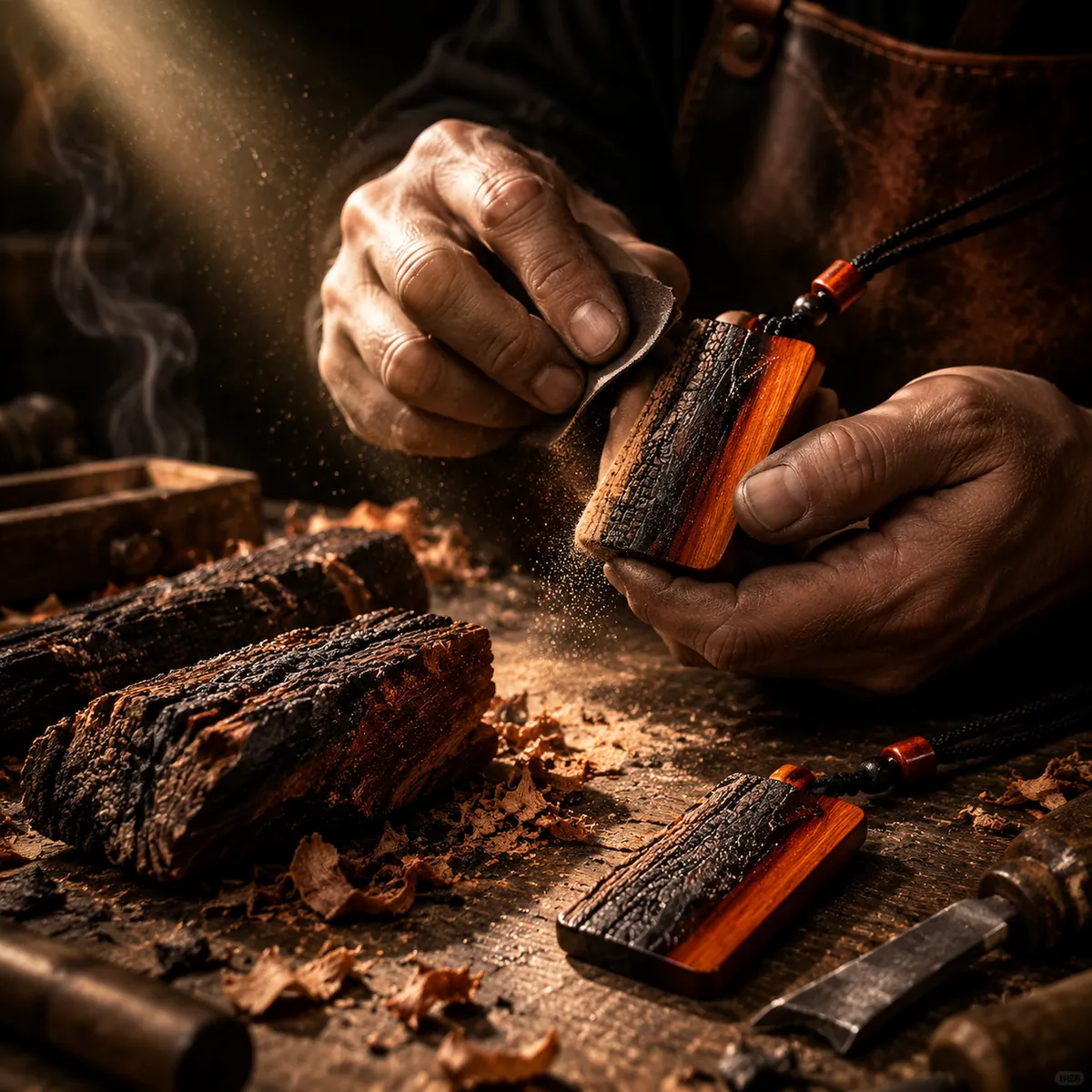
The properties of carbonized wood show up the moment a blade meets it. Sound timber beside the seam takes knife detail like any dense hardwood; the crust itself wants no such pressure — under a chisel it powders and chips, and under coarse abrasive it loads the paper black. So craftsmen trim the char’s ragged edges, smooth its face with light passes, and leave it standing flush or slightly proud, treating the seam the way they treat a knot: a feature to work with, not a flaw to erase.
Species decides how crisp that feature stays, which is why tradition settled on jujube — dense, fine-grained, slow-grown timber that holds a seam’s edges and takes a polish high enough to set the black beside it. The working properties behind that choice are the subject of our jujube wood guide.
What Should a Collector Look For?
Read the seam the way a carver does: the channel should follow the grain at natural angles, the char should sit inside the wood’s own structure rather than on top of it, and the color should grade from black through heat-brown into sound timber.
Those checks work because the changes this page describes are easy to see and hard to fake. A painted or scorched imitation sits on the surface; a real seam’s char keys into the fiber, its furrow tracks the grain’s twists, and its brown band fades outward rather than stopping. Every bolt writes a different line, so a genuine piece is one of one — part of why lightning-struck wood is rare enough to draw imitation at all.
At longhucrest, the scar is treated as the piece’s title deed: every lightning-struck jujube carving ships with the seam left visible and a hand-numbered card, and The Witness keeps one full face raw so grain, char, and the brown band between them can be read at a glance.
Frequently Asked Questions
Does lightning change wood color?
Yes. The char along the channel is near-black, and a band of wood beyond it browns from heat alone — the same darkening any wood shows when heated, concentrated into a narrow zone. The sound timber keeps its natural color, so a finished piece carries three tones: black, brown, and the species’ own shade.
How deep is the char layer?
Thin. Char is a crust that lines the walls of the torn furrow, formed in a single pulse of heat that never soaks deep. What looks like depth in a lightning seam is the wood splitting open along the grain — a tear with a shallow carbon lining, not a burn eating downward.
Can you carve carbonized wood?
Carefully, and mostly around it. The char is stable and keeps its shape, but it is brittle: under a chisel it powders, and under coarse abrasive it loads black. Craftsmen trim ragged edges and smooth the crust with light passes, doing all structural carving in the sound wood beside the seam — the approach longhucrest takes on every piece it finishes.
Does the grain change?
No. In lightning-struck wood the grain keeps its course; the furrow follows it. What the strike adds is relief — ridges and hollows along the fiber that turn the surface into a record of the event without bending or breaking the grain itself.
Does carbonization make the wood weaker?
The char itself contributes nothing structurally — it is a thin, friable crust — so what carries a piece is the sound timber around the seam. In the small-piece register, the seam is treated as a surface feature, sized and finished so no load rests on the carbonized line.
Why leave the scar visible instead of sanding it out?
Because the seam is the record, and because grinding would chew the sound wood beside it before the crust ever disappeared — the char keys into the fiber rather than sitting on top. longhucrest leaves the scar face raw on pieces like The Witness, the fastest way to read grain, char, and heat band in a single look.