
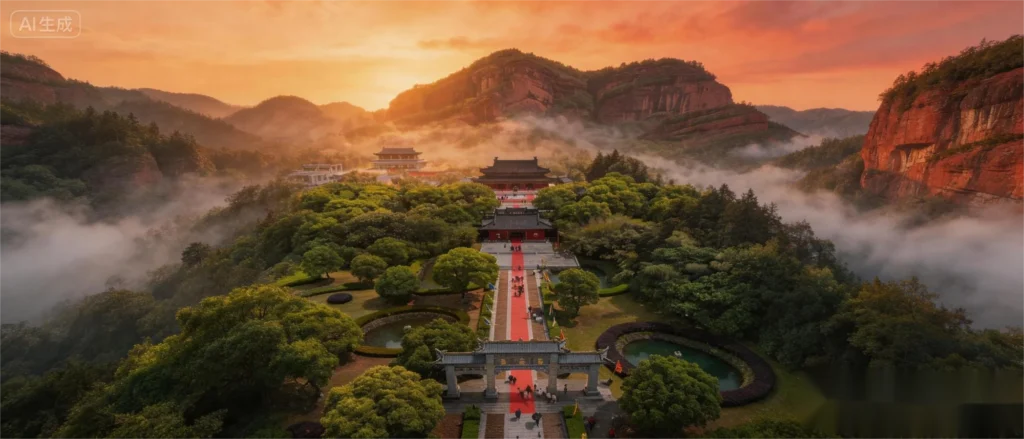
This is Longhu Mountain — Dragon-Tiger Mountain — the ancestral seat of Zhengyi, the Way of the Celestial Masters, one of the oldest living traditions of Taoism. Even the classic novel Water Margin opens at this mountain’s temple gates, when an imperial envoy releases, by mistake, the one hundred and eight demons sealed beneath the hall.
In the south of Jiangxi, China, a river called the Luxi bends between cliffs of red stone. The Chinese call this landscape Danxia — “rosy clouds” — and in 2010 UNESCO inscribed it as World Natural Heritage. On the cliffs above the river hang coffin caves placed there some 2,600 years ago by people who believed these heights touched the sky. And beside the water stands a mansion that has housed one family’s lineage for more than sixty generations, by the tradition’s own count — the Mansion of the Celestial Masters.
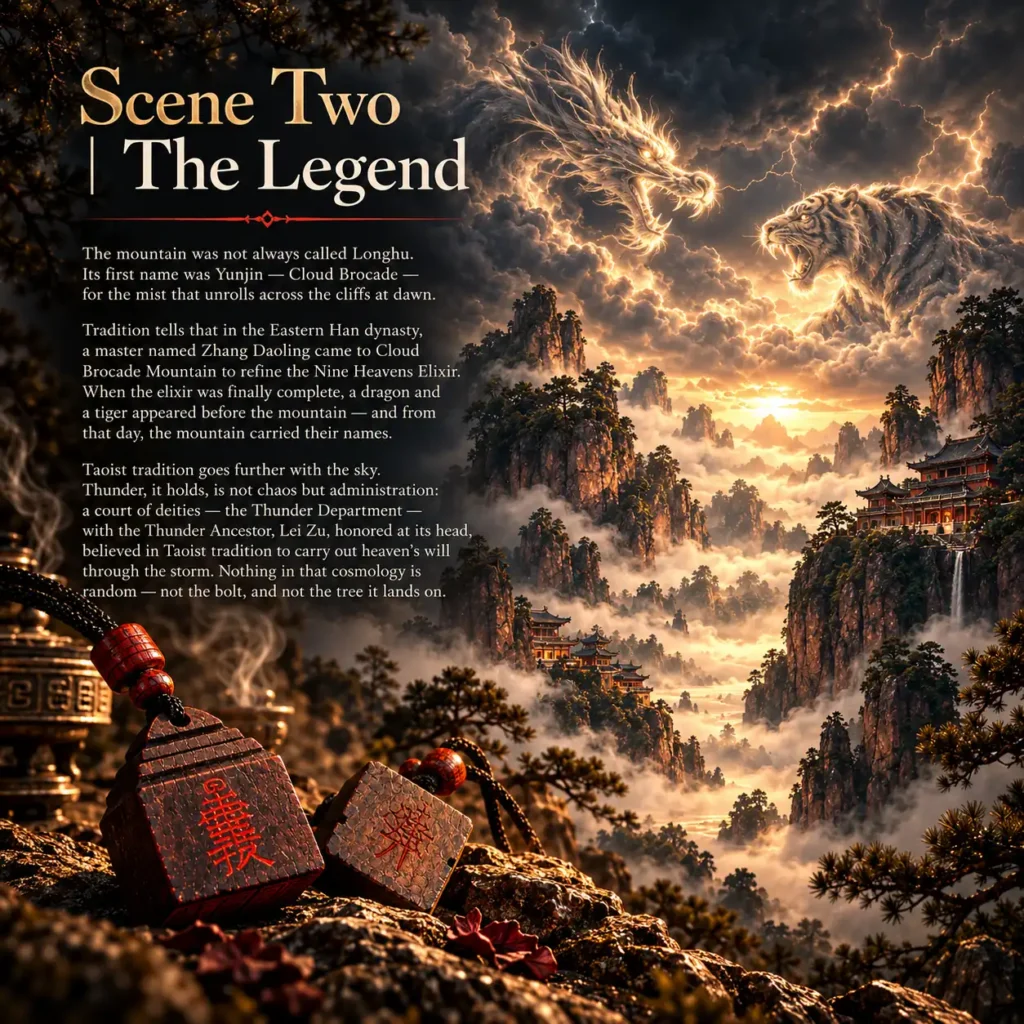
The mountain was not always called Longhu. Its first name was Yunjin — Cloud Brocade — for the mist that unrolls across the cliffs at dawn.
Tradition tells that in the Eastern Han dynasty, a master named Zhang Daoling came to Cloud Brocade Mountain to refine the Nine Heavens Elixir. When the elixir was finally complete, a dragon and a tiger appeared before the mountain — and from that day, the mountain carried their names.
Taoist tradition goes further with the sky. Thunder, it holds, is not chaos but administration: a court of deities — the Thunder Department — with the Thunder Ancestor, Lei Zu, honored at its head, believed in Taoist tradition to carry out heaven’s will through the storm. Nothing in that cosmology is random — not the bolt, and not the tree it lands on.
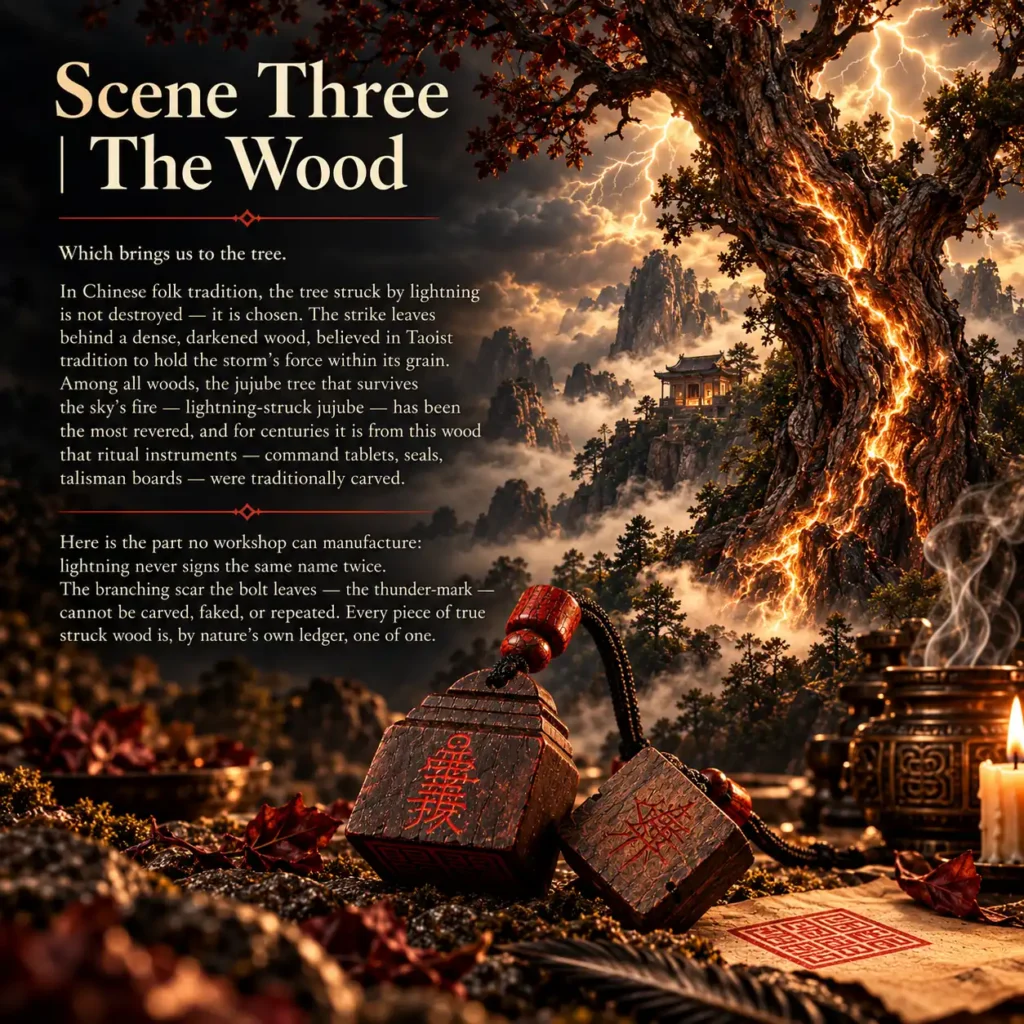
In Chinese folk tradition, the tree struck by lightning is not destroyed — it is chosen. The strike leaves behind a dense, darkened wood, believed in Taoist tradition to hold the storm’s force within its grain. Among all woods, the jujube tree that survives the sky’s fire — lightning-struck jujube — has been the most revered, and for centuries it is from this wood that ritual instruments — command tablets, seals, talisman boards — were traditionally carved.
Here is the part no workshop can manufacture: lightning never signs the same name twice. The branching scar the bolt leaves — the thunder-mark — cannot be carved, faked, or repeated. Every piece of true struck wood is, by nature’s own ledger, one of one.
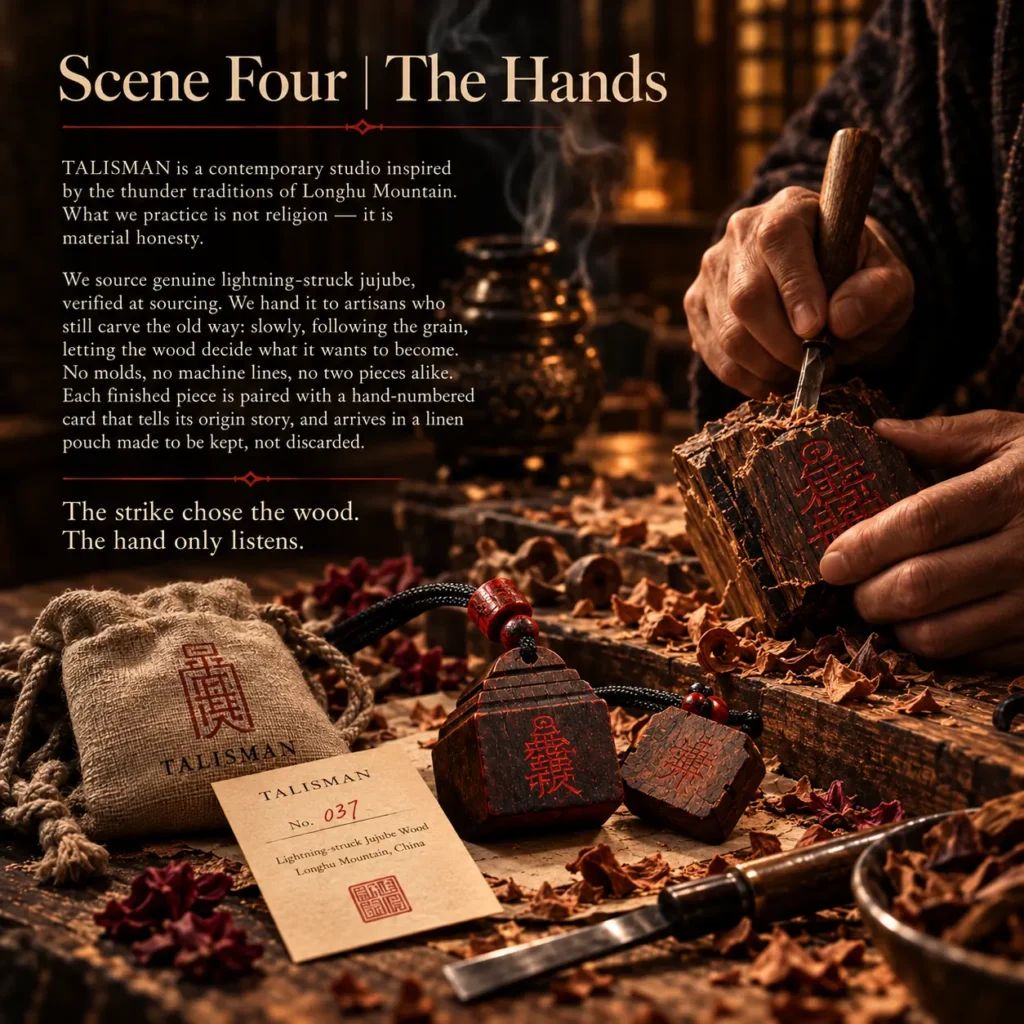
LonghuCrest is a contemporary studio inspired by the thunder traditions of Longhu Mountain. What we practice is not religion — it is material honesty.
We source genuine lightning-struck jujube, verified at sourcing. We hand it to artisans who still carve the old way: slowly, following the grain, letting the wood decide what it wants to become. No molds, no machine lines, no two pieces alike. Each finished piece is paired with a hand-numbered card that tells its origin story, and arrives in a linen pouch made to be kept, not discarded.
The strike chose the wood. The hand only listens.
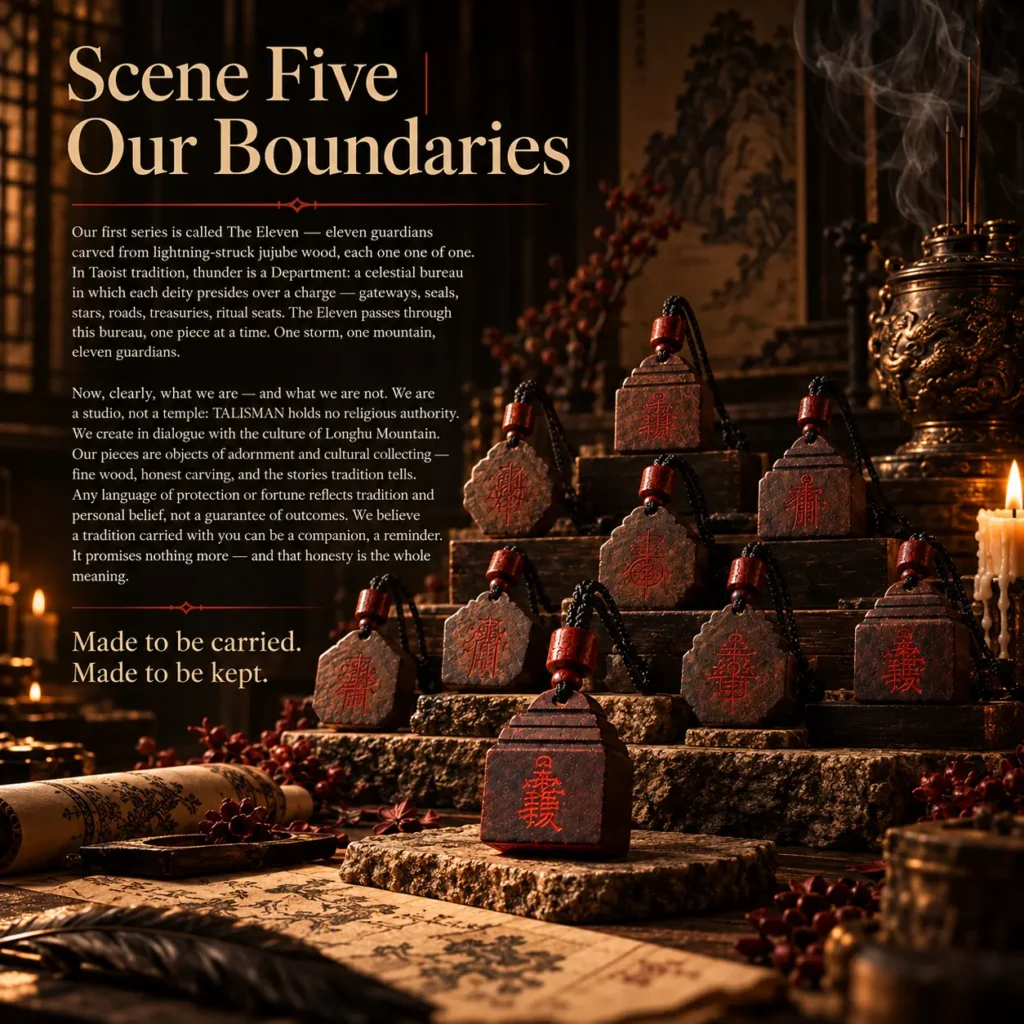
Our debut series is The Eleven — eleven guardians carved from thunder-struck jujube wood, each a singular, one-of-a-kind piece. In Daoist tradition, Thunder forms a “ministry”: a celestial mansion, where each deity presides over a distinct bureau — doorways, seals, stars, paths, treasuries, altars. The Eleven traverses this mansion piece by piece. One thunderstorm, one mountain, eleven guardians.
Now, to state plainly what we are, and what we are not. We are a studio, not a temple: LonghuCrest holds no religious authority. We create works rooted in the cultural heritage of Longhushan. Our pieces are decorative and cultural collectibles — fine timber, honest carving, and the stories handed down by tradition. References to protection or fortune reflect traditional lore and personal belief, and do not guarantee any outcome. We hold this truth: a carried piece of tradition may be a companion, a reminder. It promises nothing more — and this integrity is its whole meaning.
Made to be carried. Made to endure.