
From Order to Doorstep: What Happens After You Order a LonghuCrest Piece
In this article
Between checkout and doorstep, a LonghuCrest piece passes through four checkpoints: grain selection, carving and finishing, numbering and paperwork, and a sealed tamper-evident bag. Each step exists for a reason the material dictates — no two scars match, no two carvings repeat — and because an object sold as one-of-one needs records behind it, not adjectives. This article walks the full path for both product lines, and marks the points where you, the buyer, make an actual decision.
Choosing Your Grain
The natural line begins with wood that was genuinely struck. Villagers and mountain rangers find these pieces after thunderstorms, on slopes and ridgelines, and what the lightning left behind — a carbonized channel, a split, a twist in the grain — cannot be reordered or resampled. No two natural pieces match, which is why they are handled as one-of-one objects rather than stock. The full history of lightning-struck wood explains how a storm scar becomes a workable piece at all.
A photograph flattens the features that matter most: the depth of a carbonized channel, the way grain catches light at an angle. So the natural line works by video. After you order, we email footage of the actual piece in stock — not a representative sample, the piece itself. You watch the grain move. You approve it, or you decline it, and we ship only after you confirm. Nothing goes on the bench, and nothing goes in a box, before that yes is on file. The line currently includes two designs, The Blank and The Witness, both at the top of the range. Why the supply behaves this way — why it cannot scale — is covered in our piece on how rare lightning-struck wood actually is.

Carving and Finishing
Standard-line pieces are carved by hand from cultivated jujube wood, around whatever a given blank’s grain allows. Their storm-marks are recreated — the wood is electrically treated to mimic what a strike does — and every listing says so plainly, because story and spec stay separated on this site. Jujube is a dense fruitwood with a fine, even grain that takes detail cleanly, which is why the eleven Thunderwood Guardian designs hold crisp edges at car-charm scale; the carving properties of the wood have their own article.
Finishing is by hand as well, and one consequence is worth stating up front: a hand-carved, hand-finished piece will not match its listing photo to the pixel. Grain differs from blank to blank, and tone shifts slightly from one piece of wood to the next. That is the material behaving like material, not a defect. The listings say the same thing.
Numbering and Paperwork
Every piece is hand-numbered, and the number is written on a card that ships in the box. Functionally the card does one job: it binds the listing photographs, the design description, and the physical object into a single record. A hand-carved piece will never match its photos exactly, so the number is what says this card, this bag, and this listing all describe the same object.
The scar works as a certificate too. The deepest mark on the wood is the one feature no counterfeiter can fake convincingly and no two pieces share, and that idea — the scar is the paperwork — has its own article. Paper records matter more for a hand-made one-of-one than for a mass-produced item, for a plain reason: the claim being made is checkable, and a claim you can check is the only kind we are willing to make.
Sealed: The Tamper-Evident Bag
Every piece — natural and standard — is sealed in a single-use tamper-evident bag before it leaves the bench. The bag is transparent LDPE, printed with the words Tamper evidence bag, and it follows the security-bag format used for cash handling: a red tamper strip along the top edge, gauge marks down the side, and CUT HERE TO REMOVE CONTENTS printed at the opening end. A white serial-number barcode sticker sits on the front, in the SN00003016 format, and the bag carries printed fields for TO, FROM, PREPARED BY, DATE, ACCOUNT #, DECLARED AMOUNT, SPECIAL INSTRUCTIONS. The packaging logic itself is a long-standing discipline — tamper-evident packaging — and we did not invent it, we adopted it.
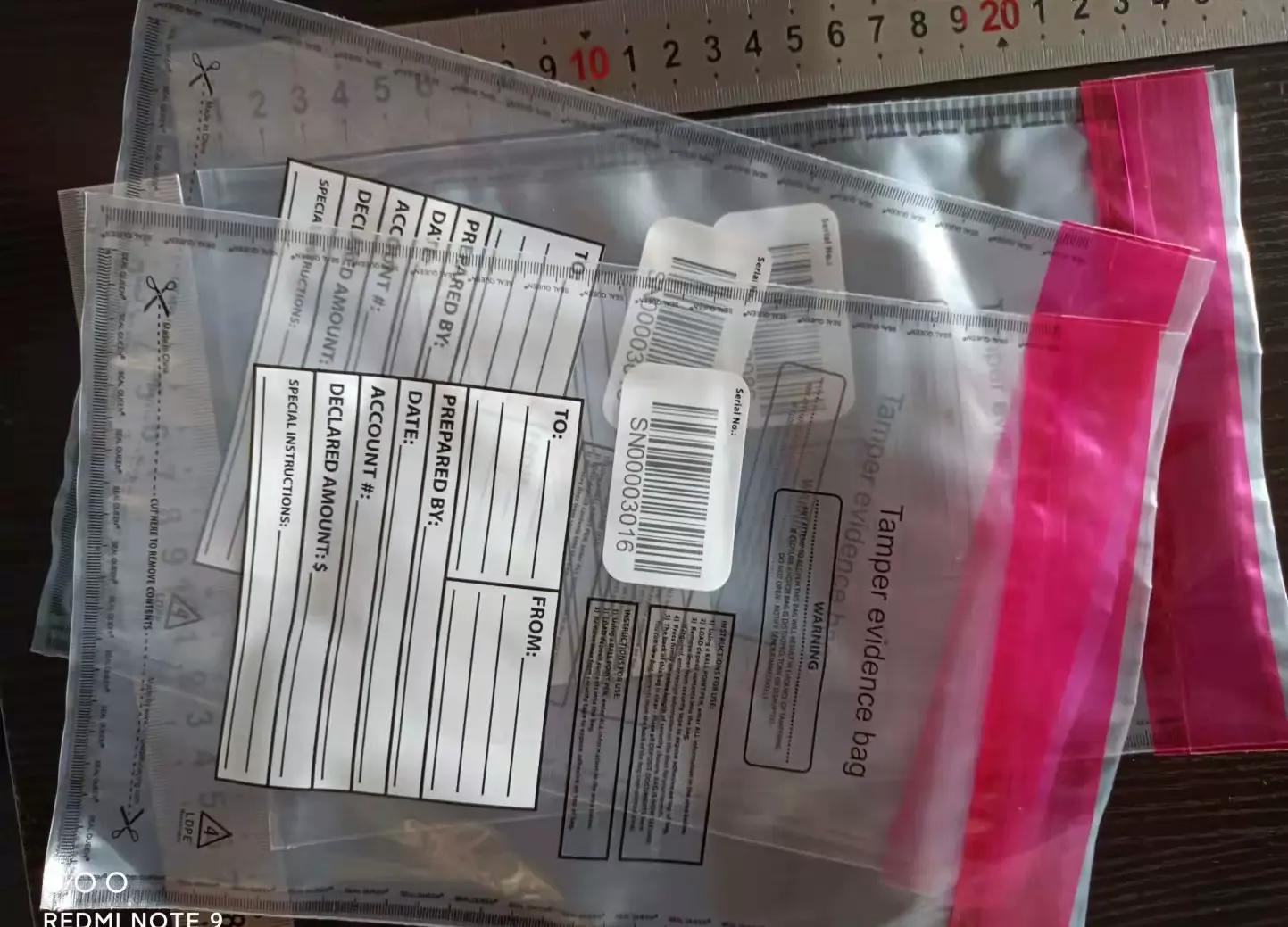
The point of the bag is that it lets you inspect without opening. You can hold the piece to the light, turn it, check the carving and the scar against the video or the listing — all while the seal is intact. That matters because of the return rules in the next section.
After It Arrives
First, look through the bag. Compare the piece with the video you approved (natural line) or the listing photographs (standard line), and check the serial on the bag against the card in the box. Everything should line up.
If it lines up and you want to keep it, cut along the marked line, take the piece out, and hang it. The care routine is short and worth doing right; we wrote it down in one place, here.
If you want to send it back, the rules differ by line. A natural piece returned unopened, seal intact, is refunded in full. Once the seal is broken, a natural piece cannot come back into stock — there is exactly one of it, and no second buyer can be offered the same object. In the old rules, a piece is believed to bond with its first keeper; we mention that as cultural background, not as the reason for the policy. The reason is inventory arithmetic. Standard-line pieces follow our normal return policy, because they can go back on the shelf.
If anything arrives damaged, write to support@longhucrest.com with photographs of the piece and the bag, seal strip included. That address is not a formality; it is the same channel that runs the video selection, and a damage claim reaches the same people who packed the box.
What We Don’t Do
Three things, listed as plainly as the steps above.
We do not ship a natural piece before you have confirmed the grain. The video gate has no skip button, on our side or yours.
We do not make outcome claims. The listings keep story and spec apart: the scar is material fact, the tradition around it is reported as tradition, and the two are not blended into promises. What the records say is what we say.
And we do not sell through other channels. The official site is the only authorized channel for the Thunderwood Guardian series; a listing elsewhere is not ours, whatever it claims. If you are comparing sellers, the questions worth asking any of them — about the wood, the records, the seal — are collected in our buying checklist.
Frequently Asked Questions
Are standard-line pieces sealed in the same bag?
Yes. Every piece, from the least expensive standard design to a $299 natural piece, is sealed in the same transparent tamper-evident bag with a serial sticker and a red seal strip. The bag is part of the handover, not an accessory for one line. The return rules differ between the lines — natural pieces are refunded in full only while the seal is unbroken, while standard pieces follow our normal return policy — but the bag, the serial, and the CUT HERE strip are identical on both.
How long does grain selection take?
Until you confirm — that is the honest answer. There is no clock we can run on your side of the gate. We send the video of the piece in stock, you watch it, and you either approve it or tell us it is not the one. If it is not the one, we film again when another piece reaches the bench. We will not hurry the step, because on the natural line the grain is the product; a rushed yes defeats the entire design. Selection ends when you say yes, not on a schedule.
What if the piece arrives damaged?
Write to support@longhucrest.com with photographs of the piece and the bag, seal strip included. Damage claims go to the same channel that runs grain selection and answers questions before an order — the people who packed the box are the people who read the email. Keep the bag and its serial sticker with the piece; the seal and the serial are part of the record, and they make a damage claim straightforward to sort out rather than a matter of one word against another.
Can I pick the grain on a standard piece?
No. Standard-line pieces are carved from stock blanks of cultivated jujube, and while the grain and tone of every finished piece differ — hand carving sees to that — the video-selection step exists only for the natural line, where each piece is a unique struck blank. If the grain is the decision that matters most to you, the natural line is the one built for that choice. On the standard line you are choosing a design and a size; the wood supplies the variation on its own.